Insurance
Your insurer has asked for a current report, or a renewal is coming up and you would rather not be caught without one.
Inspection and testing
Are you looking for commercial EICR testing in Surrey because your insurer, your landlord or your own maintenance programme has asked for a report? We would be glad to help.
We are NICEIC registered commercial electricians carrying out periodic inspection and fixed wire testing of commercial installations.
Work with us and you can expect testing sequenced so the areas that cannot lose power do not, observations coded and explained in plain terms, remedial work priced separately so you can plan it, and the report issued promptly.
So whether your premises is in Guildford, Woking, Redhill, Farnham or anywhere across Surrey, get in touch for a free, no-obligation chat to discuss your requirements and an estimate.
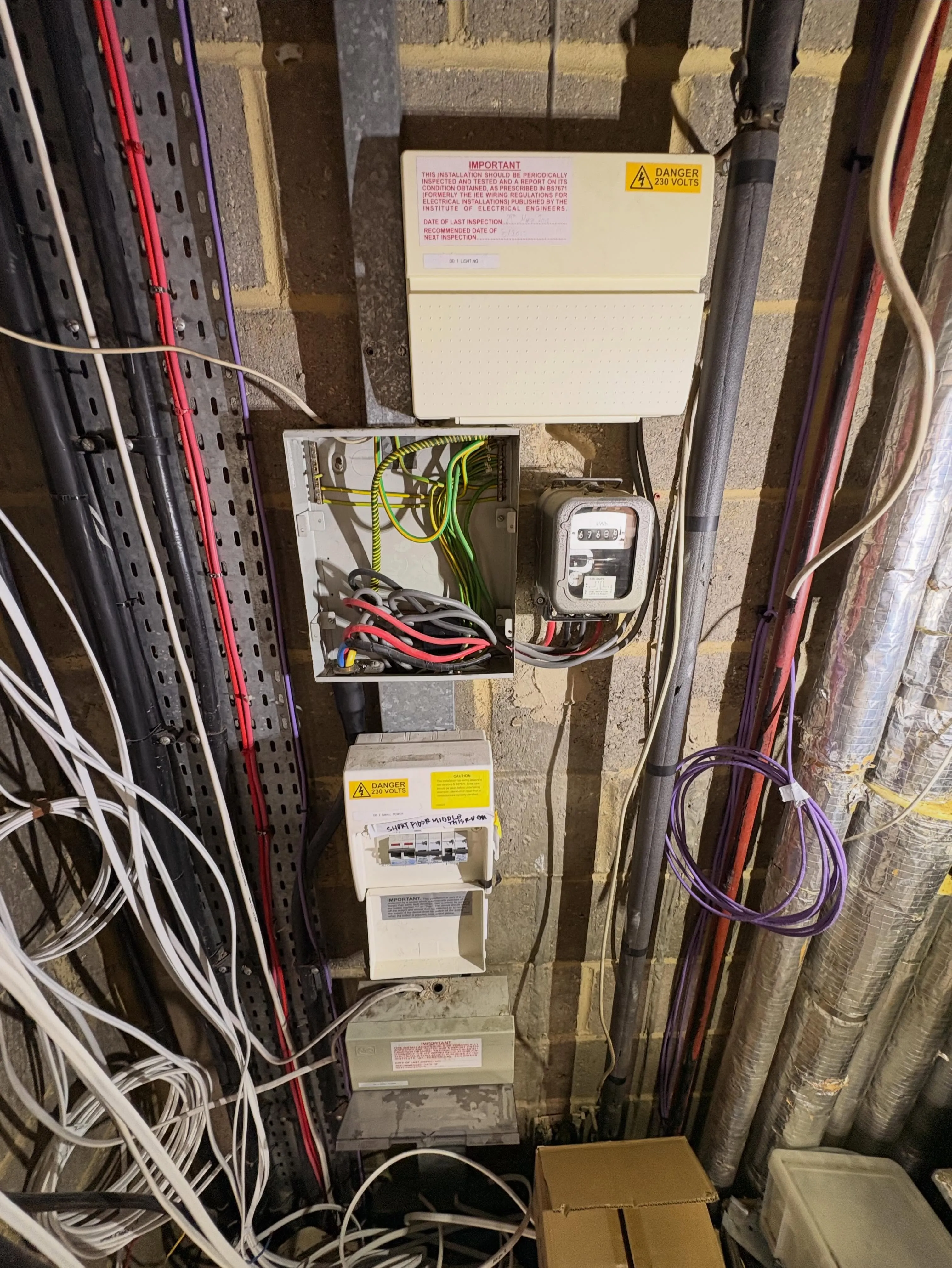
An existing installation with its periodic inspection label, recording when it was last inspected and when it is next due.
Registered & checked




What it is
An Electrical Installation Condition Report is the result of inspecting and testing the fixed electrical installation in your building: the wiring, circuits, distribution boards, accessories and earthing that are part of the premises rather than plugged into it.
It is also called fixed wire testing, periodic inspection and testing, or simply electrical testing. They describe the same exercise. The output is a report saying whether the installation is in a satisfactory condition, and listing anything that is not.
The label in the photograph at the top of this page is the small white card you find on many commercial boards: it records the date of the last inspection and the recommended date of the next. It is the quickest way to find out whether your building is overdue.
The regulations, accurately
There is a lot of loose talk about EICRs being legally required every five years. That is not what the legislation says, and it is worth understanding the real position.
The Electricity at Work Regulations 1989 place the duty. Regulation 4(2) requires that "as may be necessary to prevent danger, all systems shall be maintained so as to prevent, so far as is reasonably practicable, such danger". It says nothing about intervals or report formats. It places a maintenance duty on the dutyholder.
BS 7671 and IET guidance then set out recommended maximum intervals between periodic inspections for different types of installation. Those are starting points, not a legal ceiling, and the inspector may recommend a shorter interval based on the age, condition, use and environment of your installation.
Separately, your insurer, your landlord, a licensing authority or a client's contract may require a current report on their own terms. In practice, that is the requirement most businesses are actually responding to, and it is often more specific than the regulations.
Reading the report
Every observation in the report carries a classification code. These are the four you will see, and what each one means for you.
How we report it
The person who commissions an EICR is usually not the person who can interpret one. A schedule of coded observations written in technical shorthand is a perfectly valid report and a completely useless management tool.
So alongside the formal report we tell you, in plain terms, what was found, what it means for your building, what has to be done now and what can reasonably wait. If there were C1 items we will have made them safe and will say so.
Remedial work is priced separately from the inspection. That matters for two reasons: you can see exactly what each item costs to fix, and there is no incentive to find problems that are not there.
If remedials turn out to be substantial, it is sometimes more sensible to replace a section of the installation than to keep patching it. See rewiring and upgrades.
When businesses book one
Your insurer has asked for a current report, or a renewal is coming up and you would rather not be caught without one.
A lease renewal, a dilapidations discussion, or a landlord who requires evidence that the installation is maintained.
You are taking on a unit or a building and want to know what you are inheriting before you sign, not after.
Your installation is due under your own planned programme, or the label on the board says it is overdue.
Circuits trip, something smells hot, or the installation is simply old enough that nobody wants to guess.
Working with us
Agreed circuit by circuit so the areas that cannot lose power do not.
Send us the premises type, what you need doing and when you need it done. If you have drawings, a schedule or a previous report, send those too.
We look at the installation, agree the scope with you and put it in writing. You get an estimate you can take to whoever signs it off.
We agree dates that suit your operation, turn up when we said we would, and hand over the certification when the work is finished.
Premises
DBS checked electricians working after school, at weekends and through the holidays so teaching is not interrupted.
Lighting, small power, floor boxes and testing in occupied workplaces, phased floor by floor around your staff.
Shop fit-out wiring, display and track lighting, power and repairs, scheduled around your trading hours.
Power to kitchens and service areas, extract controls, lighting and testing for restaurants, cafés, pubs and hotels.
We carry out periodic inspection and testing throughout Surrey, in offices, schools, shops and hospitality premises. For the wider picture of what we do, see our commercial electricians in Surrey page.
Where a report raises substantial remedials, it is sometimes more sensible to replace a section of the installation than to keep patching it. See rewiring and upgrades.
More services
Most jobs cross more than one of these. If yours does, say so when you enquire and we will estimate it as one piece of work.
New circuits, small power, distribution boards, three-phase supplies and full fit-out wiring for commercial premises.
LED replacement and new lighting installations for offices, schools, shops and hospitality premises across Surrey.
Fault finding, repairs and planned maintenance that keep your premises trading and your staff working.
Emergency lighting installation, additions and periodic testing, with the certification and logbook entries to match.
Partial and full rewires, distribution upgrades and containment renewal, phased so your premises stays open.
Fire alarm installation, extensions, alterations and servicing for commercial and education premises.
Get in touch
If you're in need of trusted commercial electricians, we'd be delighted to assist. Provide a little bit of information in the form below and we'll be back to you within 24 hours to discuss further. There is no charge for the conversation or the estimate, and no obligation to proceed.
Questions we get asked
What businesses and facilities managers ask before booking testing.
There is no single number that applies to every commercial building, and any contractor who gives you one without seeing your premises is guessing. BS 7671 and IET guidance set out recommended maximum intervals, and many commercial installations sit on a five-year cycle, with shorter intervals where the type of premises, the environment or the condition of the installation justifies it.
The interval for your building depends on what it is, how it is used, how old the installation is and what the last report found. The inspector can and should recommend a shorter interval if the condition warrants it.
The legal duty is not phrased as "you must have an EICR every X years". The Electricity at Work Regulations 1989 require, at regulation 4(2), that "as may be necessary to prevent danger, all systems shall be maintained so as to prevent, so far as is reasonably practicable, such danger".
Periodic inspection and testing is the established way of demonstrating that you are meeting that duty. Your insurer, your landlord or a licensing authority may also ask for a current report as a condition of their own, and those requirements are often stricter and more specific than the regulations themselves.
It records the condition of your fixed electrical installation at the time of inspection, and gives it an overall assessment of satisfactory or unsatisfactory. Anything found is listed as a coded observation.
C1 means danger is present and immediate action is required. C2 means potentially dangerous and urgent remedial action is required. C3 is an improvement recommendation. FI means further investigation is required. Any C1 or C2, or an FI, results in an unsatisfactory report.
It is more common than people expect, particularly in older premises and in units that have been through several tenants. An unsatisfactory result is not a disaster. It is a list of things to deal with, in priority order.
We price remedial work separately from the inspection so you can see exactly what fixing each item costs and decide what to do first. Anything coded C1 gets dealt with straight away, and we will make it safe before we leave.
Some of it requires circuits to be switched off, which is the part worth planning. We work through the installation circuit by circuit and agree the sequence with you beforehand so the areas that cannot lose power at a given time do not.
In shops, kitchens and offices this often means starting early, working outside trading hours, or taking the building in sections across several visits.
An EICR covers the fixed installation: the wiring, circuits, boards and accessories that are part of the building. Testing of plug-in equipment is a separate exercise with a separate record.
Tell us what you need when you enquire and we will be clear about what is and is not included in the price.
If you need to know what condition your installation is in, and to be able to show someone else, requesting your free estimate is the right next step.