Schools and Education
DBS checked electricians working after school, at weekends and through the holidays so teaching is not interrupted.
Fire alarm systems
Are you looking for commercial fire alarm systems in Surrey for your business or education premises? We would be glad to help.
We are NICEIC registered commercial electricians who install, extend, alter and service fire alarm systems.
Work with us and you can expect systems that match how your building is used today rather than how it was laid out years ago, persistent false alarms diagnosed and dealt with, servicing recorded so you can evidence it, and a straight answer if a job would be better with a fire systems specialist.
So whether your premises is in Guildford, Woking, Epsom, Redhill or anywhere across Surrey, get in touch for a free, no-obligation chat to discuss your requirements and an estimate.
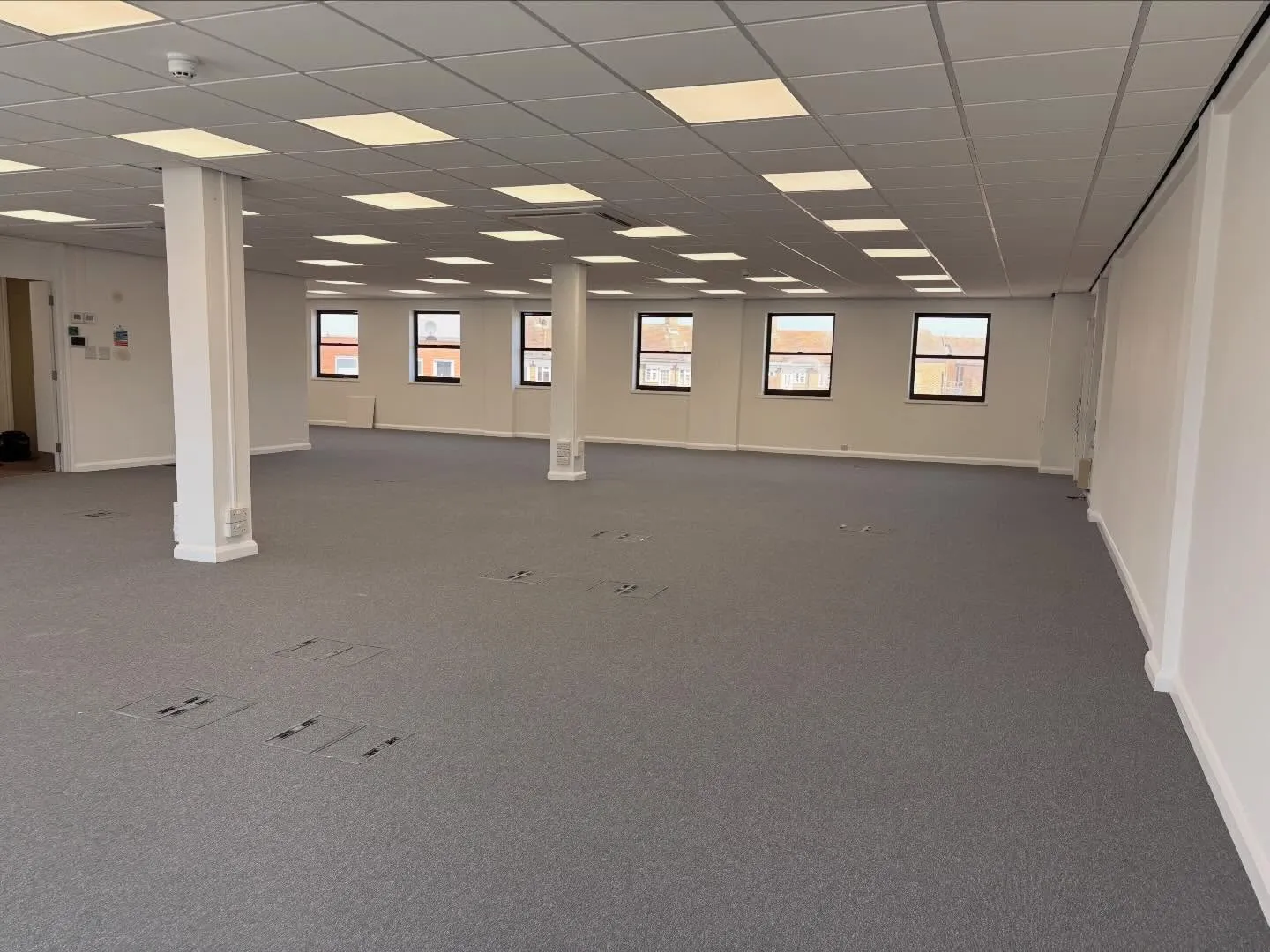
Completed office floor in Weybridge, Surrey, with ceiling detection and a call point installed alongside the new lighting.
Registered & checked




The pattern we see
Commercial buildings are altered constantly. A floor gets subdivided into meeting rooms. A stockroom becomes an office. A classroom is added. A wall comes down to open up a dining area. Each change is small, sensible and signed off on its own terms.
The fire alarm system, meanwhile, stays exactly where it was. Detection that covered an open floor now sits on one side of a new partition. A call point ends up inside a locked room. Sounders that were audible throughout are now muffled behind plasterboard.
Nothing visibly breaks. The panel shows no faults. And the system quietly stops matching the building it is protecting, which is generally discovered during a fire risk assessment, an insurance review or an inspection, at the least convenient possible moment.
Testing and servicing, accurately
Fire alarm maintenance has two distinct parts, and one of them is your responsibility rather than your contractor's.
The weekly user test. BS 5839-1, the code of practice for fire detection and fire alarm systems in non-domestic premises, sets out a weekly test carried out by the user: operate a call point, a different one each week, worked through in rotation, confirm the system responds, and record it in the logbook. It takes a couple of minutes and it is the single most useful thing you can do.
Periodic inspection and servicing. Carried out by a competent person at intervals not exceeding six months under the same code of practice. This is where devices are tested, the panel and batteries checked, and faults identified.
Alongside that, in England and Wales the Regulatory Reform (Fire Safety) Order 2005 places a duty on the responsible person to keep fire safety measures maintained in efficient working order. Your fire risk assessment and your insurer may impose additional requirements, and in practice those are often what determines your regime.
Scope
False alarms
A system that cries wolf is worse than an inconvenience. It costs you evacuated trading hours, it may cost you attendance charges, and it does something more damaging than either.
It teaches people to ignore the sounders. Once staff and customers have stood outside in the rain three times for nothing, the fourth activation gets a different reaction, and that is the one that matters.
The causes are usually identifiable:
Kitchens and food premises are a common source, which is why detection near cooking and extraction needs thinking about rather than defaulting. See hospitality electricians.
Being straight with you
We are a NICEIC registered electrical contractor. We install, extend, alter, service and repair fire alarm systems in commercial and education premises as part of our electrical work.
Where a building is complex enough to need a fire engineering design, or where a client or insurer specifically requires design or installation under a third-party fire systems certification scheme, we will say so and point you towards a fire systems specialist. Telling you that at the enquiry is more useful to you than finding it out later.
For completeness: our team holds Aico Expert Installer status, which relates to smoke and carbon monoxide alarms. That is a separate competence to commercial fire alarm systems and we do not present it as evidence for this service.
Working with us
From a single detector after a partition change to a full system installation.
Send us the premises type, what you need doing and when you need it done. If you have drawings, a schedule or a previous report, send those too.
We look at the installation, agree the scope with you and put it in writing. You get an estimate you can take to whoever signs it off.
We agree dates that suit your operation, turn up when we said we would, and hand over the certification when the work is finished.
Premises
DBS checked electricians working after school, at weekends and through the holidays so teaching is not interrupted.
Lighting, small power, floor boxes and testing in occupied workplaces, phased floor by floor around your staff.
Shop fit-out wiring, display and track lighting, power and repairs, scheduled around your trading hours.
Power to kitchens and service areas, extract controls, lighting and testing for restaurants, cafés, pubs and hotels.
We install, extend, alter and service fire alarm systems throughout Surrey, in commercial and education premises. For the wider picture of what we do, see our commercial electricians in Surrey page.
Fire alarm work often runs alongside emergency lighting, and on school sites both are usually programmed into the holidays.
More services
Most jobs cross more than one of these. If yours does, say so when you enquire and we will estimate it as one piece of work.
New circuits, small power, distribution boards, three-phase supplies and full fit-out wiring for commercial premises.
LED replacement and new lighting installations for offices, schools, shops and hospitality premises across Surrey.
Periodic inspection and testing of your fixed installation, with a clear report you can act on and hand to your insurer.
Fault finding, repairs and planned maintenance that keep your premises trading and your staff working.
Emergency lighting installation, additions and periodic testing, with the certification and logbook entries to match.
Partial and full rewires, distribution upgrades and containment renewal, phased so your premises stays open.
Get in touch
If you're in need of trusted commercial electricians, we'd be delighted to assist. Provide a little bit of information in the form below and we'll be back to you within 24 hours to discuss further. There is no charge for the conversation or the estimate, and no obligation to proceed.
Questions we get asked
What responsible persons, site managers and business owners ask us.
The established regime under BS 5839-1, the code of practice for fire detection and fire alarm systems in non-domestic premises, is a weekly test carried out by the user, operating a different call point each week and recording it, plus periodic inspection and servicing by a competent person at intervals not exceeding six months.
Your fire risk assessment, your insurer or your alarm receiving centre may set requirements of their own, and those can be more demanding. Check what applies to your premises rather than assuming the general position covers you.
In England and Wales the Regulatory Reform (Fire Safety) Order 2005 places duties on the "responsible person", in most businesses the employer, owner or occupier. That includes making sure fire safety measures, the alarm system among them, are maintained in efficient working order.
Where a building is leased or shared, responsibility can be split. It is worth establishing who holds it before an inspection asks you, not during one.
Very likely. Fire alarm design follows the layout of the building: where the detection is, where the sounders reach, where the call points sit on escape routes. Move partitions, subdivide a floor, add a room or change what a space is used for, and the original design no longer matches the building.
It is one of the most common shortfalls we come across: a system that was correct at installation and has had the building change around it since.
Usually, and it is worth doing rather than living with. Persistent false alarms disrupt your operation, cost you money if you are being charged for attendances, and, most seriously, train your staff and customers to ignore the sounders.
The causes are generally identifiable: detection of the wrong type or in the wrong position, steam or dust reaching a detector, contamination, ageing devices, or a system that was never quite right for how the building is used.
Installation, extensions and alterations to systems as premises change, replacement of ageing equipment, fault finding, and periodic inspection and servicing. We work on systems in commercial and education premises.
Where a project requires a fire engineering design or third-party certificated design for a complex building, we will tell you that up front rather than take on something that should sit with a fire systems specialist.
Yes, and it is usually more efficient. If containment is going in and ceilings are open for a lighting replacement or a rewire, running fire alarm cabling at the same time avoids a second disruption to the same areas. See rewiring and upgrades.
If your premises has changed or your servicing has lapsed, requesting your free estimate is the right next step.